-
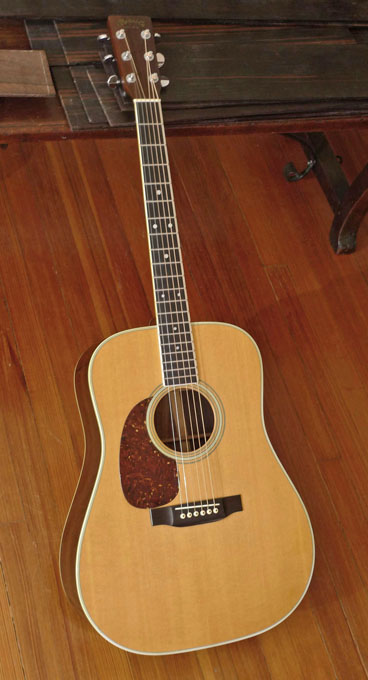 This is a wonderful, original from the factory "Lefty", a 1975 D-35L. Lefty's from this period are rare. Before the era of computerized factories, and the intro of the CNC machines at Martin, a high-end Lefty like this one was essentially a custom-made guitar. The bracing in this guitar was custom designed and built at the Martin factory for a true lefty top– this is not a regular D-35 with just different saddle and pickguard. It's built as a left-handed guitar, down to every brace. This guitar is in about as close to mint condition as you can get. The original black pickguard was lifting a bit (not from wear, there wasn't any– but just because Martin used some odd pickguard material in those years), so we just thought it would be cool to replace it with a vintage 30s style tortoise guard. I had John Allison cut a new guard, using period correct (1930's that is) nitrocellulose material. It looks great. (and BTW it's on the exact footprint of the original guard– they nudged them up a bit closer to the bridge on lefty's). This guitar sounds great. Fine, ringing trebles. Beautiful mids. It's one of the best D-35's we've played, from any period. And again, the condition is just almost mint. No cracks. No checking of finish. Everything except the pickguard is 100% original. It comes in its original hard shell Martin case, and original Martin literature from the Factory. The neck is straight, and action is perfect.
 -
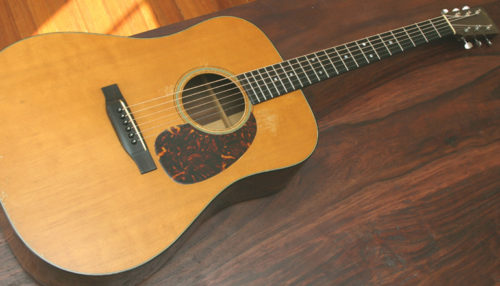 This big booming dreadnaught from one of Martin’s finest eras has everything you’d expect in volume, but it also has that wonderful sustain and ringing treble, and warm round bass, that only an almost-50-year-old Brazilian Rosewood Martin dreadnaught brings. All original throughout. Small 3 inch finish crack on lower back, stable. Typical B-string/pickguard crack, difficult to see, from bridge to beneath guard. Great original finish with minor dings and some minor pickwear around the soundhole. Ivory nut, full, original bridge and perfect condition maple bridge plate. The frets are in great condition. Rosewood fingerboard shows slight wear, nothing out of the ordinary. Frets are fine, showing minimal wear. Beautiful tortoiseshell binding in great condition, no separation anywhere. Inside of guitar shows all braces perfect–very clean and dust-free inside. Strap lug on heel and endpin. The neck was just set by Tony Nobles, and the action is low, with no buzzing. You can play it hard. It was fitted with a new bone saddle with the neck set (the original ivory saddle is in the case). Brazilian rosewood D-size Martins, from the era when Martin still used hide glue for guitar construction, are highly sought-after. This one, in this condition, will go quickly.
 -
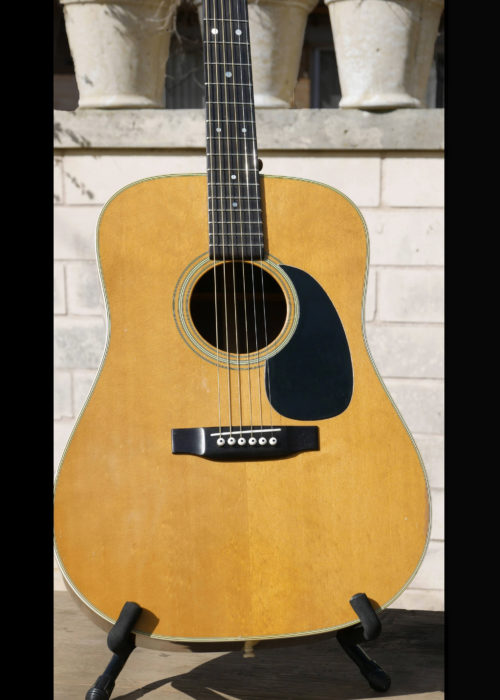 Many players consider the best Martin D-28’s from the 70’s great guitars– and the best value around if you want a vintage D-28 on a budget. The best ones deliver great tone– a darker, richer voice than 50's or 60’s D-28’s. The non-adjustable truss rod, and great Indian rosewood Martin used in those years, and the nice bear claw sitka on top on this example, all make for a lovely instrument. A few nicks and dings, but in remarkable original condition. This instrument delivers. It’s all original, and it’s 100% crack-free (not even the common “pickguard crack”). The original pickguard is not lifting as you often see on these Martins. Original bridge that's never been off the guitar, pins, everything. It has the typical slight finish crazing on top, visible from an angle– it’s common on this vintage. The neck has never been set. Frets in fine shape. Original Grovers. With a low-ish saddle, it plays fine. And in tune everywhere. At some point in the future the new owner may want to do a neck set, but we prefer to keep it all original (and the action is fine as is). ... no longer available – see the newly listed 1970 Martin D-28 in the Featured Instruments section.
 -
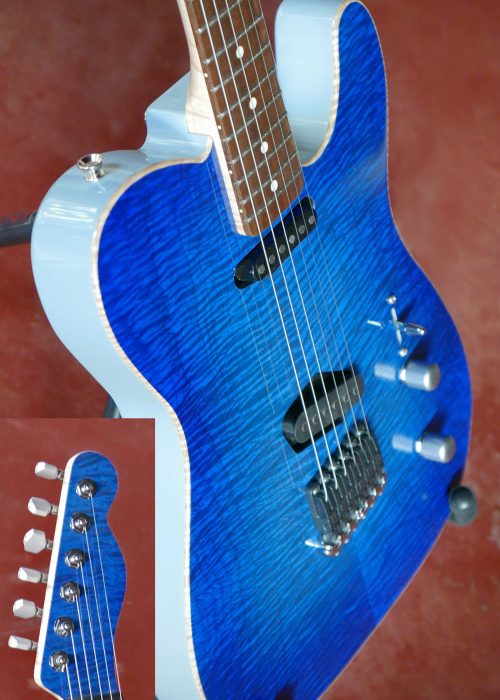 Tony Nobles "Coney Island Custom" Tele Guitar Master luthier Tony Nobles, based in Wimberly, Texas, needs little introduction. He’s been crafting custom guitars for years, quietly, without much hype, for artists ranging in style from Joe Walsh to Alejandro Escovedo. This guitar is fun, unique (it’s one of one), and draws on the DNA of some interesting sources. Starting with: the fretboard is made from rosewood salvaged from the actual Coney Island Boardwalk when they rebuilt it a few years ago. So it's a piece of history. Cut to chase on this unique guitar:
- Top: bookmatched Maple; Natural Maple top binding
- Nitrocelulose lacquer finish
- Musikraft neck, maple, with rosewood fretboard made from salvaged wood from the actual Coney Island Boardwalk (when they tore down the old boardwalk for reconstruction, and the wood was preserved by architects/preservationists)
- 25.5" Scale
- Width at the Nut: 1-11/16"
- Width at the Heel: 2-3/16 (55.56mm)
- Number of Frets: 21
- Fret Type: Medium 6105
- Finger Board Radius: 10"
- Back of neck: natural, no finish
- Front of headstock, blue to match body
- Bridge: Schaller, imported from Germany, chrome
- Tuners: Sperzel Trimlok Locking Guitar Tuners 6-in-line Trim-Lok SATIN CHROME
- Volume and tone knobs: brushed satin chrome
- Pickups: Harmonic Design "54 special" for the bridge pickup; and Harmonic Design "MiniStrat" for the neck pickup
-
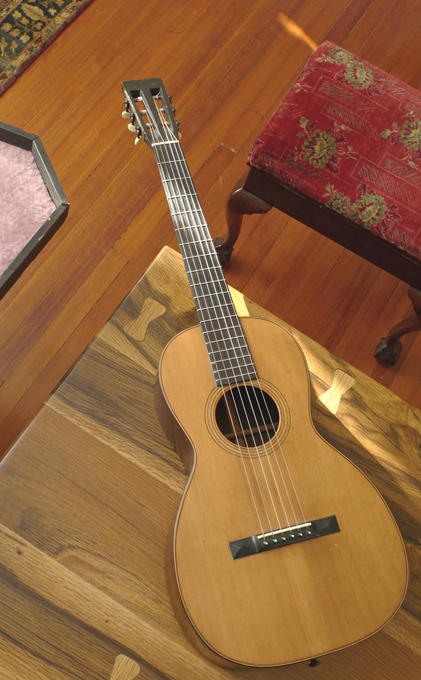 Another all-original pre-war Martin… but you have to go back a few more wars on this one- to just after the Civil War. This guitar even has its original coffin case–necessary in the days when Martin guitars were shipped out by railroad or wagon train. The figured Brazilian rosewood back and sides are unusual– in these decades of the 19th century (and through the middle of the 20th) Martin usually did not use this kind of figured, lovely Brazilian (they preferred the more straight-grained variety). On this guitar, for the sake of originality, we’ve kept its original saddle intact. The original ivory saddle is worn through at the strings, but still functions nicely.
- Fan braced
- Adirondack top
- Ebonized “ice cream cone” style neck
- Solid Brazilian rosewood back and sides
- 100% original finish…. No overspray, touch-up, etc. anywhere…wonderful finish
- Original ebony bridge, and bridge plate
- Two cracks in spruce top; one is bridge to bottom of top; the other is from near bridge to soundhole; first one described is beneath an internal brace; second is 2mm adjacent to a different brace. Neither need attention and are left alone to preserve originality.
- Characteristic, three Martin stamps: “CF Martin & Co, New York” ink stamped on neck block; “CF Martin & Co, New York” ink stamped on center strip inside; and “CF Martin New York”, stamped/pressed into brazilian rosewood back of guitar, up near the heel. (note: this guitar is not signed personally by factory foreman, etc, on underside of top…. This fact, and the other details, points to a circa 1870 date, not 1880s or 90’s).
-
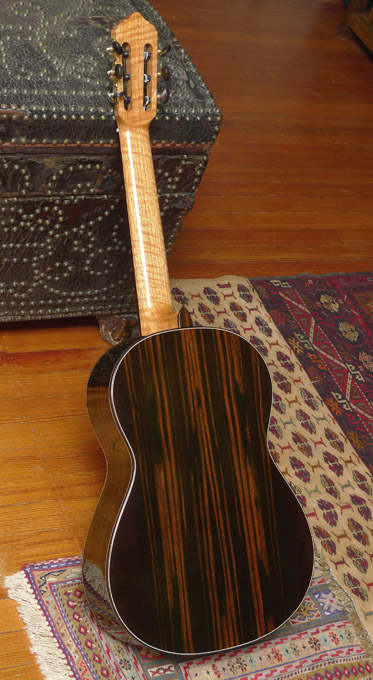 Vustom made Lester Devoe Flamenco Negra, a one-of-a-kind, Brazilian Rosewood guitar, from one of the world’s top luthiers. Lester Devoe needs no introduction to the world’s great Flamenco players. The late, legendary Sabicas played a Devoe– and converted some of the great Flamenco players in Spain to the fold. Paco De Lucia, and Vicente Amigo, among others, play Devoe Flamenco guitars. (I personally delivered a Devoe Flamenco Blanca guitar to Paco De Lucia in Spain in late 2010– Paco likes his Devoe’s hand-delivered. Paco De Lucia began playing a Devoe Negra guitar years ago– and there are many Paco De Lucia recordings and feature films where Paco plays a Devoe Flamenco guitar.) And it’s rare that Lester makes a Negra with Brazilian rosewood of this age and quality.
- 650mm scale length
- Nut: 52mm
- Neck width at nut: 52mm
- String Spacing at nut: 44mm
- 80 year old Brazilian Rosewood (pre-CITES) back and sides (Quartersawn).
- European spruce top, with some beautiful and understated “"hazelfichte" (what Americans call bear claw).
- Custom, flamed Spanish Cedar neck
- Brazilian Rosewood headstock overlay, and bridge
- Brazilian Rosewood body binding, top and back
- Ebony fingerboard
- Sloane tuners
- Austere yet elegant Santos style black and white rosette, that Devoe uses only rarely, on top custom models
- Nitrocellulose lacquer finish
-
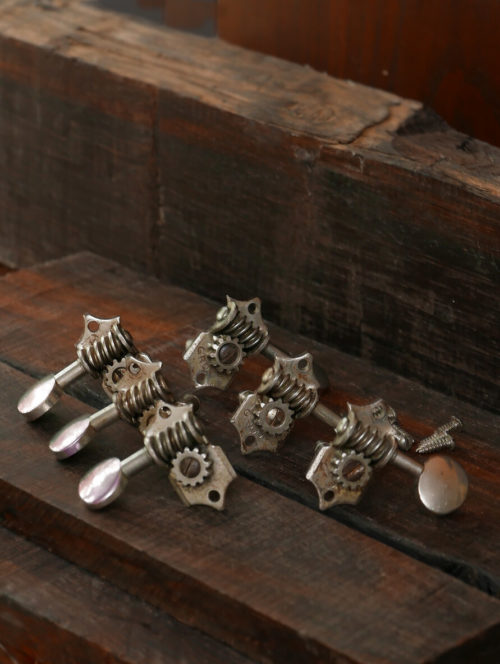 6:1 ratio pre war Grovers, mid-1930's. As used on Martin pre-war dreadoaught guitars. Oval buttons, bevelled edges on the baseplate. Just one button has some missing chrome on one side (see photos). With bushings, and mounting screws. No bent shafts. Good working condition. Price: $795.
 -
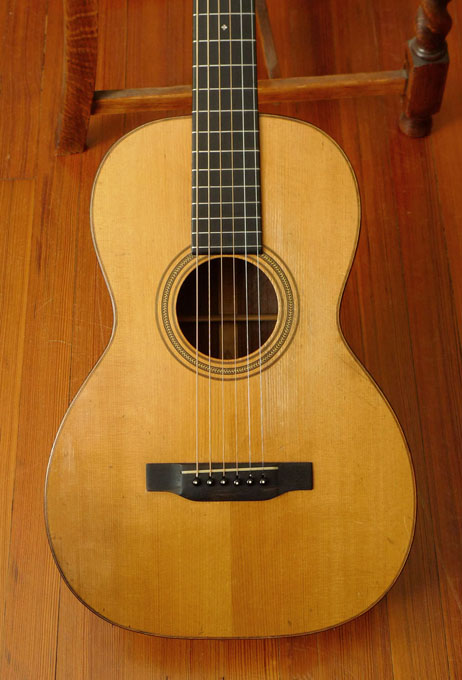 This is a wonderful Martin 0-21, but with “the best of both worlds”: the light build of 1924– combined with 1930’s robust, “braced for steel” construction. It left the factory in 1924, but it went back to Martin in 1934 for a neck set, new belly bridge, and to get set up fully for steel strings. Details below.
- All original finish
- Original 1934 bridge, and bridge plate from Martin Factory
- Original saddle
- Original “arrowhead” design tuners. The first Waverly tuners showed up in 1924/25 and remained until after the war. The arrowhead design, seen here on the tuner plates, showed up also in 1924, still with the shafts placed underneath the gears / string posts.
- Crack free (there is one cleat inside guitar, on upper bout, back. There is no visible crack that goes through wood to inside, just a tiny finish crack on outside. No doubt the Martin luthier place the cleat there in 1934 as a preventative measure (that worked).
- The combination of the original thin-profile neck, with the braced-for-steel modifications by Martin factory in 1934, make for a very robust guitar– you can play it hard and it holds up and projects like a 30’s Martin.
- Sold by Martin factory and shipped to Rudolph Wurlitzer Co. in Chicago on March 18, 1924. (This guitar does not have “Wulitzer” stamps, rather the normal CF Martin Stamps in all the correct places. This is consistent with Martin/Wurlitzer timetable in “Martin Guitars: A Technical Reference” by Johnston and Boak, 2009, p. 248.)
- June 20, 1933: the owner wrote to Martin that instrument needed a neck set and the bridge was “adrift”. Martin replied on June 23 that the normal guarantee would probably cover this work.
- Owner sent the guitar to Martin on July 3, 1934. Martin reported back to owner on July 16 that readjusting the neck and regluing the bridge would be covered by the warranty, Martin also offered a “new” bridge (meaning belly bridge) for $1.50. Martin also said that some binding could be reglued and repaired for $3.00.
- Work done at Martin, July 1934. The luthier at Martin replaced the bridge with a 1934 spec ebony belly bridge, and replaced the bridge plate with a perfect, tucked, small maple bridge plate. Martin luthier signs underside of spruce top: "7-25-1934”, and put his initials (“W.T.W.”), right by the edge of the X-brace to the top/upper bout. Of course, the back was taken off the guitar to do the above work. But being perfectly done at Martin factory in 1934, there are no visible signs of that– back binding is perfect.
- Total repair bill from Martin factory in 1934: $4.50. Paid by check, and Martin return ships the 0-21 to owner on August 15th, 1934.
-
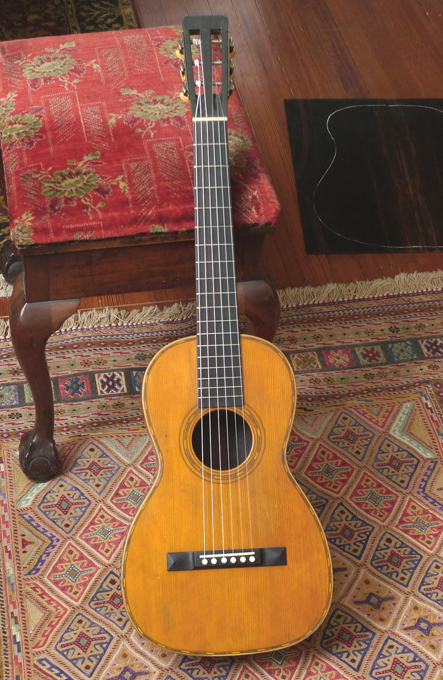 A rare, wonderfully-preserved, 1854 Schmidt & Maul. It’s signed and dated inside: Louis Schmidt Tompkinsville Staten Island New York 388 Broadway August 18th 1854 U. S.
- Adirondack top
- Ebonized “ice cream cone” style neck
- solid brazilian rosewood back and sides
- fan braced
- marquetry Purfling around top, with Maple binding
- Maple binding, back
- Width at lower bout: 11 ½ inches
- 100% original finish. No overspray, touch-up, etc. anywhere…wonderful finish
- Not a crack on top, or sides. One small dryness crack on back, near the edge binding on treble side
- Original bridge plate, in great condition
- Reproduction, correct, Ebony bridge
- Bar frets replaced with period correct Bar frets from TJ Thompson
-
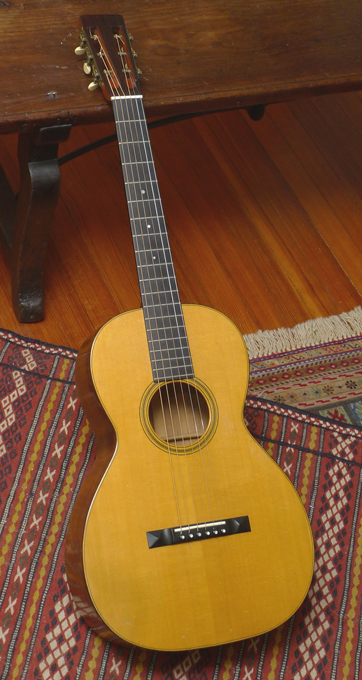 The grandson of Martin Guitar founder C. F. Martin, Sr., Frank Henry Martin suddenly found himself in control of the family business at the age of 22 when his father died in 1888 and left him unexpectedly in charge. The guitar market was still immature, and the young country was headed into an economic panic in the 1890's, but the young Frank Henry Martin quickly turned a traditional German business close to bankruptcy into a major force in the world of American music. Along with the young Frank Martin’s now legendary work ethic and marketing acumen, he is credited with personally revamping the Martin model line-up at the turn of the new century. Eschewing the trappings of an executive, he literally worked along side the shop craftsmen, day in and day out, six days a week. And he made the Style 18 the mainstay of the Martin catalog. This instrument is a living testament to that legacy– he personally signed this instrument, in cursive, under the top, on the fourth of February, 1907: “ 10381 2/4/07 F.H.M. ” Martin was still using Brazilian Rosewood for the back and sides for their 0-18 model in this 1907, and the tone of this instrument reflects all that is great about the combination of Brazilian back and sides, and Adirondack spruce (top), with a cedar neck, on the perennially great Size 0 Martin 12-fret, in all its Brazilian rosewood permutations through two centuries. This guitar is in remarkably original condition, and is completely crack-free. Just a few minor dings and superficial scratches. The finish is 100% original, with no touch-ups of any kind. The bar frets were replaced by us with period-correct bar frets–with material obtained from T.J. Thomson. (Several frets were missing, so we decided to replace all the frets.) Original ivory saddle, and bridge pins. Bridge has never been off the guitar. At some time in the past a neck set was done, so action is great, and the neck is straight. Original ebony nut is in the case. An ivory nut is installed on the guitar to accommodate silk & steel strings–which it does wonderfully. An Adirondack/Brazilian 12-fret 0-sized Martin over a century old yet in this kind of original condition, is very rare.
 -
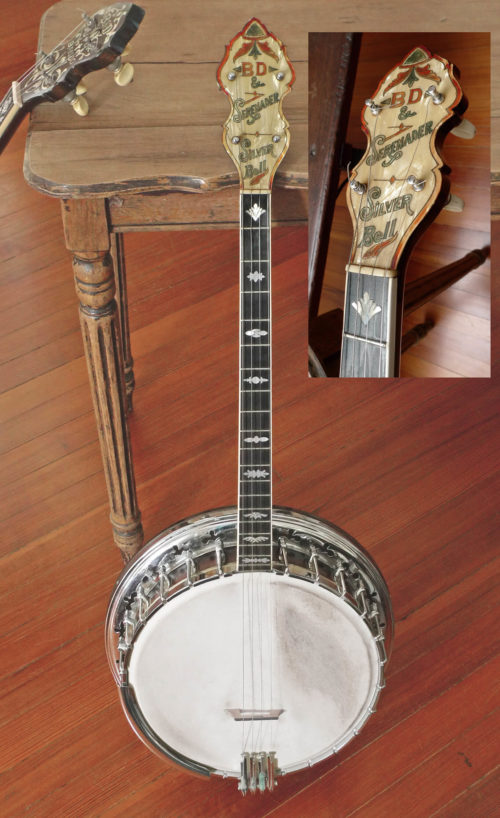 This 1922 Bacon & Day Serenader, tenor banjo is in great original condition. The well-worn head can be easily replaced– we retained it for originality. The banjo shows little wear. And all the parts are original–Tailpiece, tuners, dowel, everything. This is a golden era B&D, not one of the later 30s/40's banjos that are more common. In this condition it is rare. And it comes in its original hard shell case. Price: $1695.
 -
 The Larson Brothers need little introduction to the world’s top players and collectors, and they are very different instruments from the Martin and Gibson instruments that dominated the 1920’s and 30’s by their shear numbers. Larson instruments are rising in value rapidly, as they never produced the kind of volume that Martin much less Gibson produced in those decades, and they are now recognized for their magnificent workmanship and tone. The now legendary Chicago-based Larson brothers, August and Carl, did not make instruments with a “Larson” label. All of their instruments were branded and marketed for Stahl, Maurer, Prairie State, Euphonon, Dyer, Bruno, and a few more. Yet every one of their instruments has their unmistakable trademarks. And their unmistakable tone. This exquisitely beautiful, 100% original Larson Mandolin was made at the very height of the Larson legacy– when they were making their finest instruments. It has all of the Larson trademarks that set apart the best Larsons, including “built under tension” design, and Larson’s classic “ebony under the binding” on the neck. Every part of this instrument is 100% original. And its crack-free– save for two tiny dryness finish cracks near center of back, of about two inches each.
- 100% original finish, everywhere
- Scale length: 13 inches
- Nut width: 1 1/8 inches
- Serial number: 38764